What Is Timestral? Mistral’s Time-Series Foundation Models (2026)
 Timestral Team
Timestral is Mistral’s family of open time-series foundation models: 5M, 28M, 123M and 209M parameters, zero-shot probabilistic forecasting, CPU inference and a 32,768-step context.
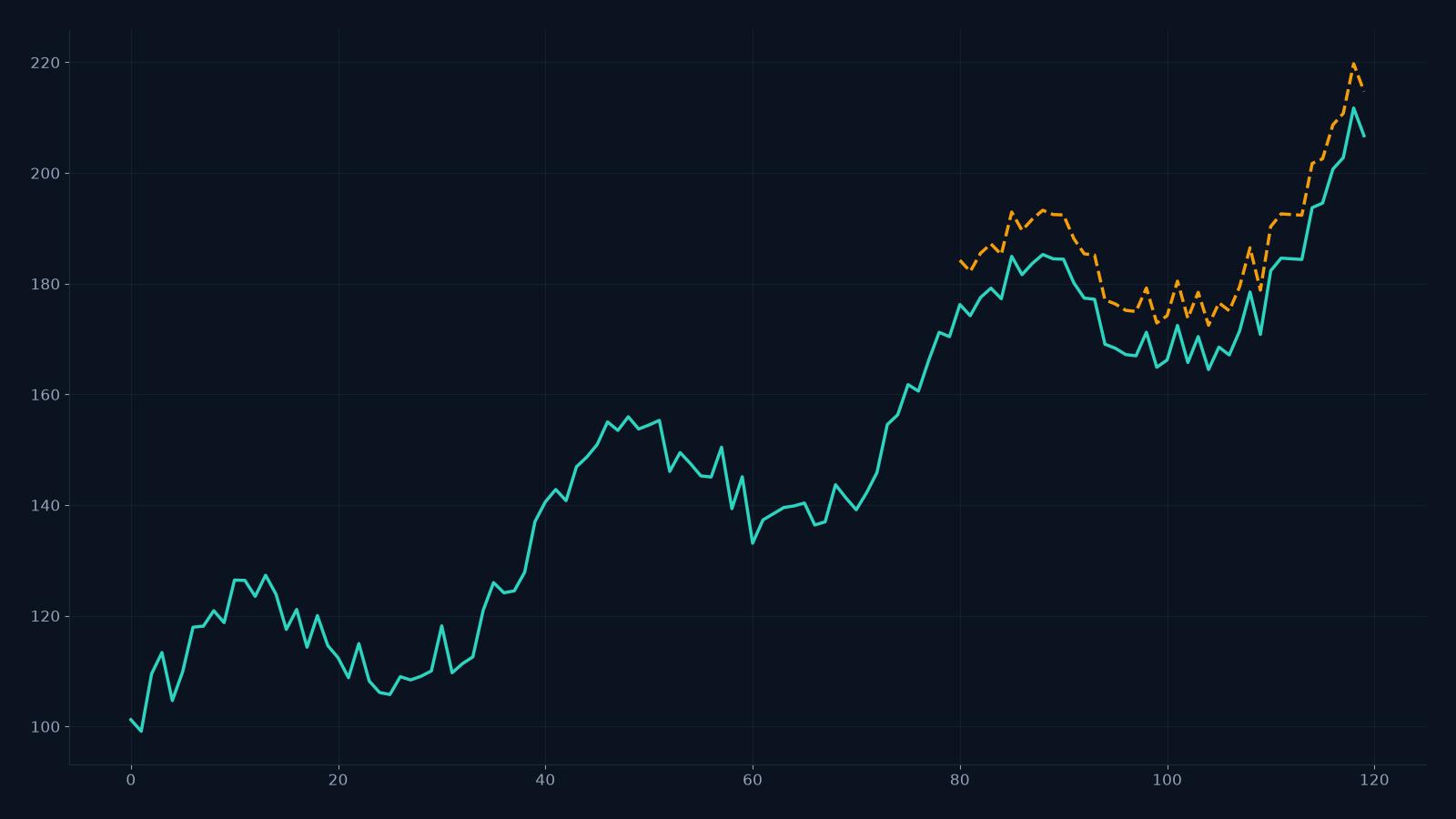
Timestral is a family of time-series foundation models released by Mistral AI in October 2026. It is not a video model, a chatbot, or a general-purpose LLM. It reads a sequence of measurements over time — sales, traffic, temperature, load, sensor readings — and forecasts what comes next, with a range that expresses uncertainty.
The family has four sizes: 5M, 28M, 123M and 209M parameters. They share an architecture and training recipe. The 209M model is the largest; the 5M model is small enough to run on a modest CPU. All four are designed for zero-shot forecasting: you can point them at a new series without training a model first.
This page explains what Timestral does, what it does not do, how the pieces fit together, and how to try it on your own CSV.
CSV forecast studio
Paste a series, get a probabilistic forecast.
One value per row, or a date column plus one or more numeric columns. Timestral returns a median forecast and a likely range. The demo runs on the public Hugging Face Space; the API is the paid product.
The one-paragraph version
Timestral takes a history of one or more numeric series and returns a probabilistic forecast: a median path plus quantiles that describe the likely range. It handles multivariate series, covariates, missing values and long contexts up to 32,768 time steps. It can run on CPU. The largest model is 209M parameters, which is small by LLM standards and large by classical forecasting standards.
If you need a point forecast, you can take the median. If you need to plan for uncertainty — inventory, staffing, energy, capacity — the quantiles are the useful part.
What “zero-shot” means
Most forecasting projects start with model selection, feature engineering and training. Zero-shot means the model has already learned transferable temporal patterns from a large corpus of synthetic and real series. You give it your history at inference time; it does not update its weights.
That has three consequences:
- You can forecast a new series immediately. No training run, no hyperparameter search, no GPU.
- The model is generic. It has not seen your business rules. A promotion, a price change or a one-off factory shutdown is not in its weights; you have to encode those as covariates or handle them outside the model.
- Fine-tuning is optional. Mistral positions Timestral Forge for teams that want to fine-tune on proprietary data. For many short-horizon problems, zero-shot is enough to establish a baseline.
The four sizes
| Model | Parameters | What it is for | | -------------- | ---------: | ---------------------------------------------------------------------- | | Timestral-5M | 5M | Fast, cheap, edge and high-volume batch | | Timestral-28M | 28M | A middle ground; Mistral reports it beats Chronos-2 on some benchmarks | | Timestral-123M | 123M | More capacity for complex or multivariate series | | Timestral-209M | 209M | The largest; best accuracy, still CPU-friendly |
The size is a trade-off, not a ranking. A 5M model that answers in 10 ms may be more useful than a 209M model that answers in 140 ms if you are scoring thousands of SKUs every hour. Start with the smallest model that clears your accuracy bar.
Probabilistic output: 21 quantiles
Timestral returns 21 quantiles per forecast step. The exact levels are part of the model; the studio shows a median and an 80% band by default, and the downloadable CSV contains all 21.
Why quantiles matter:
- A point forecast hides risk. “Demand will be 100” is very different from “demand will be between 70 and 140.”
- Inventory, staffing and capacity decisions depend on the tail, not the middle.
- A forecast interval lets you measure calibration: when the model says 80%, the outcome should fall inside the band about 80% of the time.
The studio renders the median and the band; the CSV gives you every quantile for your own downstream calculations.
Multivariate series and covariates
Timestral can forecast several related series together. The Space accepts up to 8 numeric columns. That matters when the series share structure:
- electricity load and temperature
- website sessions and ad spend
- production output and machine vibration
- sales across related SKUs
A multivariate model can use the shared pattern. It is not a causal model: it learns correlations, not interventions. If you change a price, the model will not know the causal effect unless you give it a covariate that encodes the change and the history contains similar changes.
Long context
The model supports up to 32,768 time steps of context. That is long enough for several years of hourly data or decades of monthly data. Long context is useful when the series has slow cycles, regime changes or long-range dependencies. It is not free: more context means more compute and, sometimes, more noise. The studio lets you cap the history to the last N points.
CPU inference
Mistral reports that on a standard server CPU with eight threads, forecasting one day ahead from three weeks of 15-minute data takes about 10 ms with the 5M model and 140 ms with the 209M model. Those are vendor numbers; your latency depends on the number of series, the horizon and the machine.
The practical implication is that you do not need a GPU to run a forecasting service. A CPU worker can handle a useful volume of requests. For batch scoring, the small models are especially attractive.
What Timestral is not
- It is not a video generator. If you arrived looking for text-to-video or image-to-video, this is a different Timestral.
- It is not a causal inference engine. It forecasts patterns; it does not tell you what happens if you change a price.
- It is not a replacement for your data pipeline. Garbage in, garbage out. Missing values are tolerated, but a broken timestamp column will produce a broken forecast.
- It is not a guarantee. Benchmark leadership does not mean it will beat a simple seasonal baseline on your series. Always backtest.
How to try it
The studio on this page accepts a CSV with an optional date column and up to 8 numeric columns. Paste a series, choose a horizon, and run the forecast. The public demo runs on the Hugging Face Space; the API is the paid product for production use.
If the demo is busy, the Space is over its ZeroGPU quota. The embedded demo at the top of the page uses the same model and may still work. For a reliable production path, use the API with a dedicated quota.
What to read next
- How to format a CSV for Timestral — the exact input shape.
- Probabilistic forecasting and the 21 quantiles — how to read the band.
- Timestral vs Chronos-2 and statistical baselines — a testable comparison.
- API pricing — forecast credits and plans.
FAQ
Is Timestral the same as Mistral’s LLM?
No. Timestral is a time-series foundation model family. It is not a chat model and does not generate text or video.
Do I need a GPU?
No. The models are designed for CPU inference; the 5M model is especially fast. A GPU helps at high volume, but it is not required to start.
Can I use my own data?
Yes. Paste or upload a CSV. The model does not train on your upload; it uses the history you provide for that forecast.
Is it free?
The public demo is free while the Hugging Face Space is available. The production API is metered in credits. There are no free API credits.